

REIF
for companies
Access to financing
Financial trust REIF
The Renewable Energy Innovation Fund finances investment projects for the incorporation of technologies or infrastructure aligned with the second energy transition, under flexible and favorable conditions.
This innovative instrument uses a trust to channel UN funds, which it combines with commercial banking, to catalyze investments that contribute to decarbonizing industry and transportation.
Companies interested in applying for financing should do so through our partner banks.
For questions about projects and applications for REIF funding, please contact the following e-mail: info@reifuruguay.org
17
Funded projects
30
MMCatalyzed investment
partners : co-financiers
Financial institutions that have cooperation agreements with REIF Uruguay.








Request Technical Assistance
Target
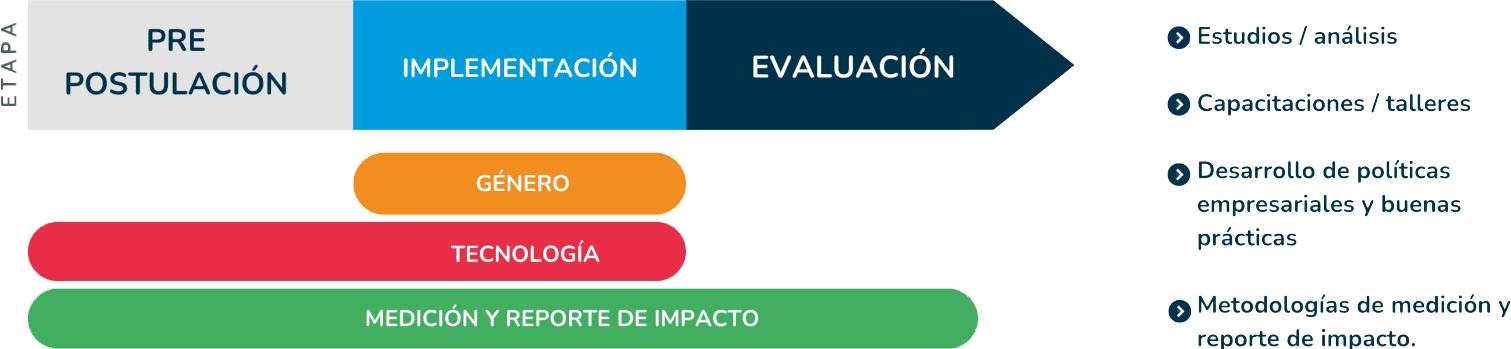
REIF has non-reimbursable funds to assist companies that require support to measure and enhance the economic, social and environmental impact of their investment projects, as well as to carry out feasibility studies and validation of technologies and business models, prioritizing innovative projects.
Technical assistance is granted based on the recommendation of the Investment Committee, which will analyze each case individually. This assistance consists of hours of support from experts, at no cost to the beneficiary companies. They have different objectives and can be applied in the pre-application, implementation and evaluation stages of the project.
Technical Assistance - Technology
FAQs
Projects requesting technical assistance must fall within one of the four technology verticals financed by REIF.
In turn, projects requesting technical assistance must present an element of innovation and/or technological risk that justifies the dedication of hours of expert assistance to study a new business model in a specific market, delve into available technologies and suppliers when they are scarce in the market, or incorporate new elements to the project that improve performance and can be replicated.
In this regard, technical assistance will not be granted to projects with technologies already proven in Uruguay that do not have a differential value with respect to existing projects in the country.
Applicant projects must be reasonably developed, have evaluated current and future operating conditions and identified available technologies and equipment and estimated investments and costs, thus enabling REIF's participation in the financing to be assessed.
Not necessarily. Technical assistance may be granted during the REIF's pre-application phase.
The purpose of the pre-application technical assistance will be to support/deepen the analysis of the technology or business model of the project, which will allow the company to validate its suitability. If the analysis is positive and the company decides to execute the project, it will be able to use REIF as a source of co-financing. If the analysis concludes that it is not convenient, or the company decides not to execute the project, it will have no commitment with REIF.
The implementation technical assistance will be associated with a credit granted by REIF as co-financier and will be aimed at supporting the company in the implementation of the technology, reducing the project's risk.
No, they have no monetary cost, but they do require in all cases the involvement of people from the company. It is necessary to have dedication on the part of the organization, so that there is an appropriation of the processes and knowledge transferred.
Technical assistance must be formally requested, via e-mail, by the company that will carry out the project/investment, attaching a request note signed by a representative.
The request note must propose a consultant or consulting firm to carry out the technical assistance. To do so, it is suggested to visit the list of REIF consultants.
Ideally, the company will select the consultant at an early stage, allowing its involvement in the design of the project, the definition of the activities to be performed and products to be delivered.
Mail should be addressed to the following persons and addresses, copying the proposed consultant or consulting firm:
- Antonio Martínez, director of REIF - amartinez@reifuruguay.org.uy
- Pablo Caldeiro, REIF's energy expert- pcaldeiro@reifuruguay.org.uy
We suggest, prior to completing the note, to contact the members of the REIF Investment Committee indicated above for guidance and to outline the proposed activities.
REIF has a registry of consultants and consulting firms authorized to provide technical assistance. The consultants proposed by the company must be registered and have a background in the technological area to be addressed. This information is available in the List of Qualified Consultants.
If the consultant or consulting firm that the company wishes to apply for is not already registered, it must complete the Application Form to join the consultant registry.
The evaluation will take into account the background information submitted, and will be included in the registry to provide technical assistance in the verticals and technologies where sufficient experience is accredited.
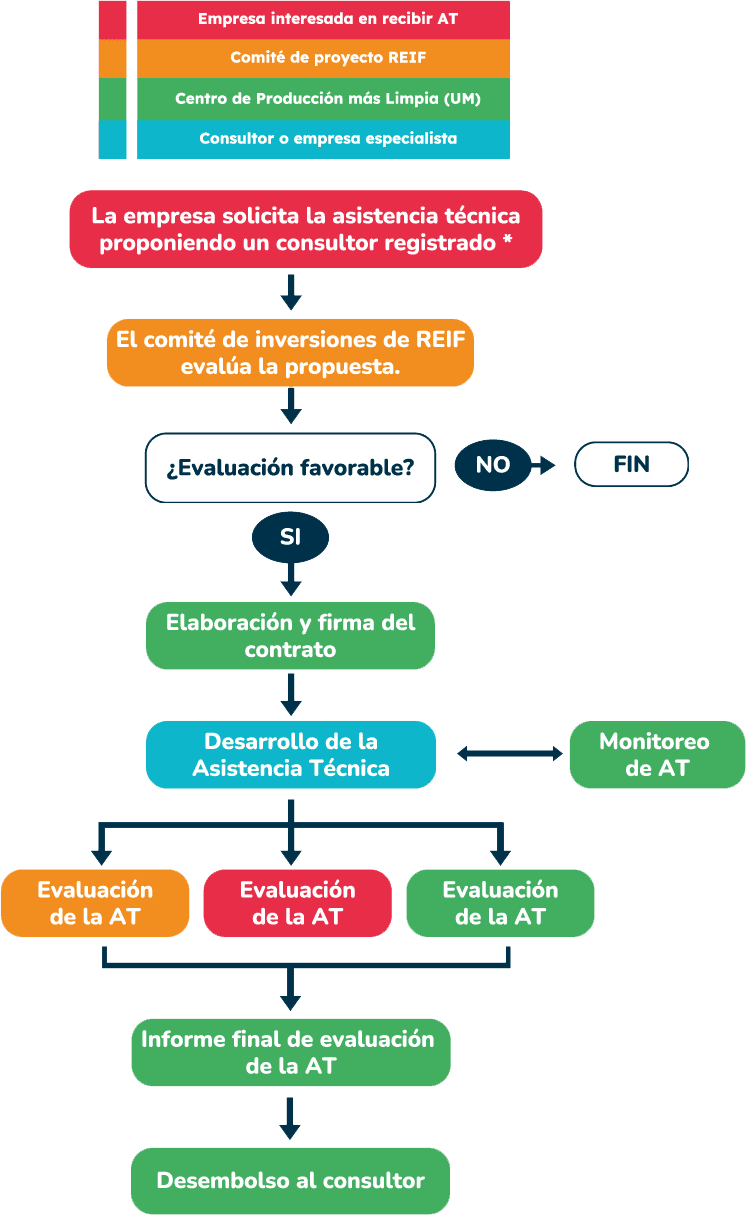
Once the request for technical assistance has been received, it will be evaluated by the members of the REIF Investment Committee, who will define its relevance, the consultant's suitability, the specific activities, the expected results, and the conditions in terms of hours effectively recognized and execution time.
The previous exchanges between the company, consultant and experts of the investment committee will be a particularly valued element in order to reach an agreement between the parties.
The result of the evaluation will be communicated via e-mail, and if positive, the contract will be signed to begin.
In case the REIF Investment Committee approves the technical assistance, a tripartite contract will be signed: Beneficiary company, Consultant or consulting company that will develop the TA and the entity that manages the TA on behalf of REIF (University of Montevideo).
Through an agreement, the Cleaner Production Center (CPmL) of the University of Montevideo will support REIF in the contracting and follow-up of technical assistance, in order to have an agile and efficient service.
The contract establishes the commitments of the parties, including the activities to be performed, estimated hours and amount assigned to the consultant, the time frame for execution and penalties in case of noncompliance.
Please refer to the model contract for technical assistance.
The term shall be agreed between the parties, with a maximum term of 90 days. An extension may only be granted for duly justified reasons.
In all cases, the payment of fees to the consultant or consulting firm will be made by REIF through the UM Cleaner Production Center, for 100% of the agreed value, once the technical assistance is completed, with the approval of the REIF Investment Committee, the UM Cleaner Production Center and the beneficiary company.
Deliverables to validate the performance of the technical assistance will be defined in the contract. There is no specific format for the final report to be submitted by the consultant or consulting firm, however, the information should be sufficient to validate the correct execution of the activities.
Technical assistance request flow for technology incorporation.
Documents of interest
Technical Assistance - Impact and Gender
FAQs
In the pre-application phase:
If there is a need to strengthen the impact thesis behind an investment project, there is the possibility of obtaining technical assistance in impact to prepare the application.
In the implementation phase (once the loan has been approved):
All projects with a credit approved by REIF will receive impact technical assistance for monitoring and follow-up of the environmental and gender indicators of the financed project. This consists of support to the company in designing the process of monitoring, surveying and recording the environmental variables and metrics proposed in the framework of the project and included in the contract. In terms of gender, the company must adhere to UN Women's WEPs (Women's Empowerment Principles), and if it does not have a diagnosis, assistance will begin with the application of the specific tool.
In turn, REIF has a menu of assistance options to deepen aspects of environmental management and management with a gender perspective, which may be requested according to the needs identified in the investment project or in the company where it is carried out, once the loan has been approved.
Not necessarily. Impact technical assistance may be provided in the pre-application phase to strengthen the impact thesis behind the investment project to be presented to the REIF investment committee.
In the pre-application phase :
In the case of needing support in the impact analysis for the development of the application, the company should make a request to the REIF Investment Committee. The mail should be addressed to the following persons and addresses:
Antonio Martinez, Director of the REIF Investment Committee - amartinez@reifuruguay.org.uy amartinez@reifuruguay.org.uy
Ester Zaha, National REIF Impact Expert - ezaha@reifuruguay.org.uy
In the implementation phase (once the loan has been approved):
Once the loan has been disbursed, the UN team in charge of impact technical assistance will contact the company to assess the needs and formulate an appropriate proposal.
Technical assistance on impact will be supervised by qualified personnel from the United Nations in Uruguay and executed by personnel specifically contracted for this purpose by the same organization.
Technical assistance must have a recommendation from the Investment Committee (both in the pre-application phase and in the implementation phase). Subsequently, the United Nations team, together with the company, will define the scope of the technical assistance, defining objectives and a work plan for its development.
The term shall be agreed between the parties, and may not be extended beyond the term of the credit granted.
Deliverables to validate the performance of the technical assistance will be defined in the contract. There is no specific format for the final report to be submitted by the consultant or consulting firm, however the information should be sufficient to validate the correct execution of the activities.
No, they do not have a monetary cost, but they do require in all cases the involvement and work of people from the company. It is necessary to have hours and work on the part of the organization, so that there is an appropriation of the processes and knowledge transferred.
Technology verticals financed by REIF

Energy storage and demand management
Technologies aimed at improving imbalances between renewable energy supply and energy demand, and replacing fossil fuels by improving system efficiency. Includes behind-the-meter (BTM) storage technologies such as batteries and heat pumps.

Power to X
Technologies aimed at transforming electrical energy into other types of energy with storage capacity. Includes technologies that use electricity for heat generation (Power to heat) such as electric boilers or direct heating equipment (furnaces, dryers, heaters) and technologies that use electricity for hydrogen generation (Power to hydrogen).

Waste management and treatment technologies
Technologies to address the challenges of waste treatment and management. Includes technologies for battery recycling and management, biogas generation for thermal uses, combustion of organic waste as boiler fuel (e.g. rumen).

Electric Mobility
Technologies and infrastructure for electric mobility. Includes electric buses, light-duty electric vehicles, electric utility vehicles, electric passenger vehicles, as well as the development of charging facilities for electric mobility.
