Loading...

Since the first oil crisis in 1973, the concept of efficient energy use has permeated globally, with countries and companies understanding its importance and developing specific policies. This involves strategies and the use of technologies to reduce energy consumption, the natural resources used to generate it, and costs.
The heat pump is a technology used in air conditioning, and the equipment that uses it can heat (and/or cool) domestic water or air. In the last decades, the development of heat pumps has had a sustained growth, mainly because it is a highly efficient technology, with energy consumption of about 30% of other conventional equipment (electric heaters, stoves, boilers, etc.), delivering the same thermal energy.
These energy savings typically translate into lower lifetime costs, making heat pump technology very attractive for residential and commercial sectors (e.g. air conditioning), as well as in industry, where it is already possible to use them in high temperature water and steam heating applications.
On the other hand, the improvement in energy efficiency is associated with lower greenhouse gas (GHG) emissions due to lower consumption, an effect that becomes more significant when equipment that uses fossil fuels (natural gas, fuel oil, etc.) is replaced.
Advanced algorithms and Artificial Intelligence (AI) are gaining a foothold in all sectors, and the energy sector and energy efficiency are no exception. AI can - for example - analyze consumption patterns and energy tariffs in real time, to reduce costs and unnecessary energy consumption.
In the case of air conditioning in large rooms, the traditional design establishes a parameter value (setpoint) of the heat pumps adjusted for extreme conditions, which occur only a few days a year. On the rest of the days the system is not operating optimally. Advanced algorithms make it possible to incorporate weather forecasts and other parameters dynamically, adjusting the setpoint for system optimization, with improved energy efficiency and year-round comfort.
Carrasco International Airport was a pioneer in Uruguay by integrating heat pumps into the heating system in 2016. MCT was the company selected for the development and implementation of the solution, with the aim of advancing sustainability and energy efficiency. One of MCT's partners, Martín Garmendía, tells us that "At that time, it was a practically unknown technology in the country; we had to contact and develop suppliers, as well as MCT's own internal knowledge to put it into operation."
The airport has large internal spaces, which must be kept air-conditioned under strict conditions for the comfort of users, representing a challenge in terms of standards, but also in terms of efficiency and costs.
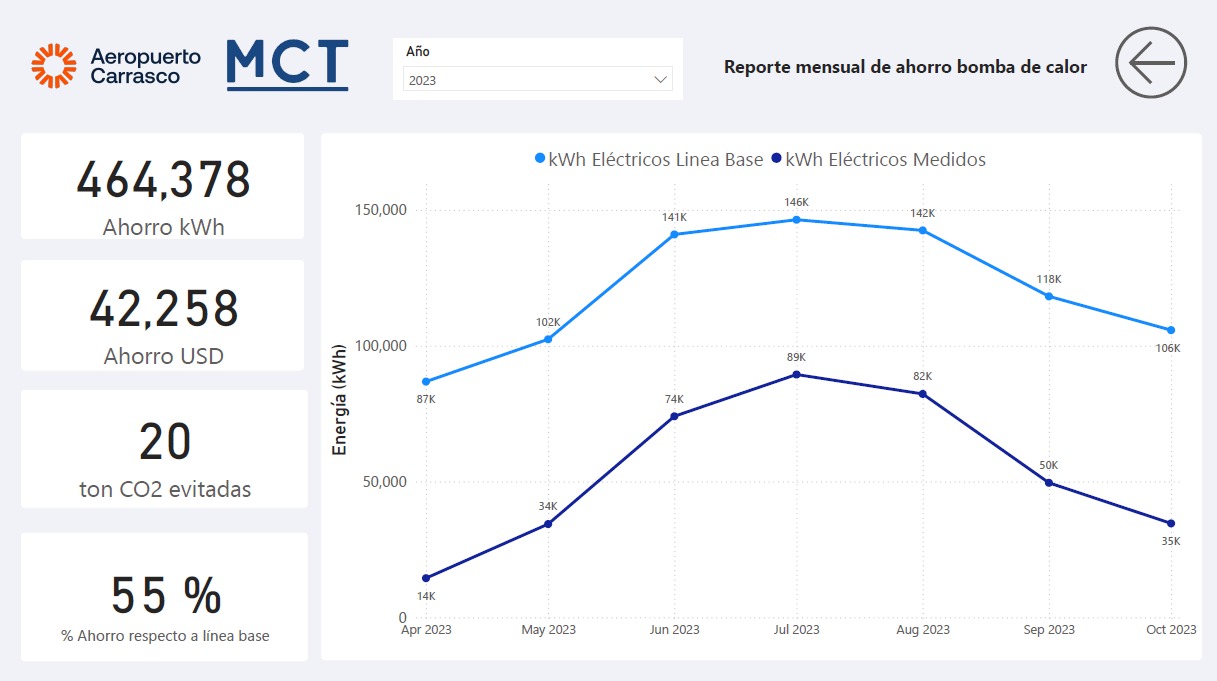
The visionary decision significantly improved energy efficiency while eliminating the use of fossil fuels, marking a milestone in sustainability. From the implementation of the heat pump project in 2014 to 2023, consumption at the airport was reduced by 20% with the same level of comfort, achieving annual savings of 1,230 MWh, equivalent to the annual consumption of 3,500 households.
Nowadays heat pump technology has become popular, however, important opportunities have been detected to go a step further in energy efficiency in air conditioning, aided by AI solutions. MCT developed an innovative solution for Carrasco International Airport, which, based on building characteristics, real-time climate data in 30 indoor sectors, and weather forecasts, continuously adjusts the setpoint of the hot water generation equipment and controls the speed of the fans.
The advanced control algorithm has been evolving in the new versions, and the results have led to a 57% reduction in energy consumption in 2023 compared to 2021.
MCT is currently working on other large space heat pump projects, and on the introduction of advanced air conditioning optimization solutions. HVAC (heating, ventilation and air conditioning) systems have the potential to incorporate such advanced solutions into existing systems, and learn to bring the operation to high levels of energy efficiency and cost reduction.
Martín Garmendía comments: "We have detected a growing interest on the part of our clients in incorporating advanced air conditioning solutions, and financing with preferential conditions can play a catalytic role in the incorporation of the technology. We see the option of REIF co-financing with banks as an excellent tool to make the projects a reality".
REIF promotes the adoption of second energy transition technologies in Uruguay through blended-finance financing with local banks, offering preferential rates and grace periods adaptable to the needs of the companies or ESCOs that wish to finance themselves.