Loading...

The global battery market is at an inflection point due to the growing demand for storage for renewable energy and the electrification of transportation. Currently, lithium batteries dominate the industry, but an alternative technology is gaining ground: sodium batteries, which use sodium (Na) as a substitute for lithium in the cathode and electrolyte.
Although the principle of operation is similar, the difference between lithium and sodium batteries lies in the abundance of sodium, which is 1,000 times more abundant than lithium in the earth's crust, making it much cheaper to extract and produce. While the cost of lithium carbonate has reached up to US$20,000 per ton in some markets, sodium is considerably cheaper, estimated at around US$150 per ton.i
Currently, sodium is extracted mainly from minerals such as halite, which is abundant in countries such as China, India and the United States, while lithium comes largely from salt flats in Argentina, Bolivia and Chile, as well as in Australia.ii
In a growing energy storage market, driven by the transition to renewable energies and the search for energy efficiency, it is essential to evaluate and diversify alternatives. In this context, the comparison between lithium and sodium technologies allows identifying their respective advantages and challenges, responding to the need for viable and sustainable solutions for energy storage.
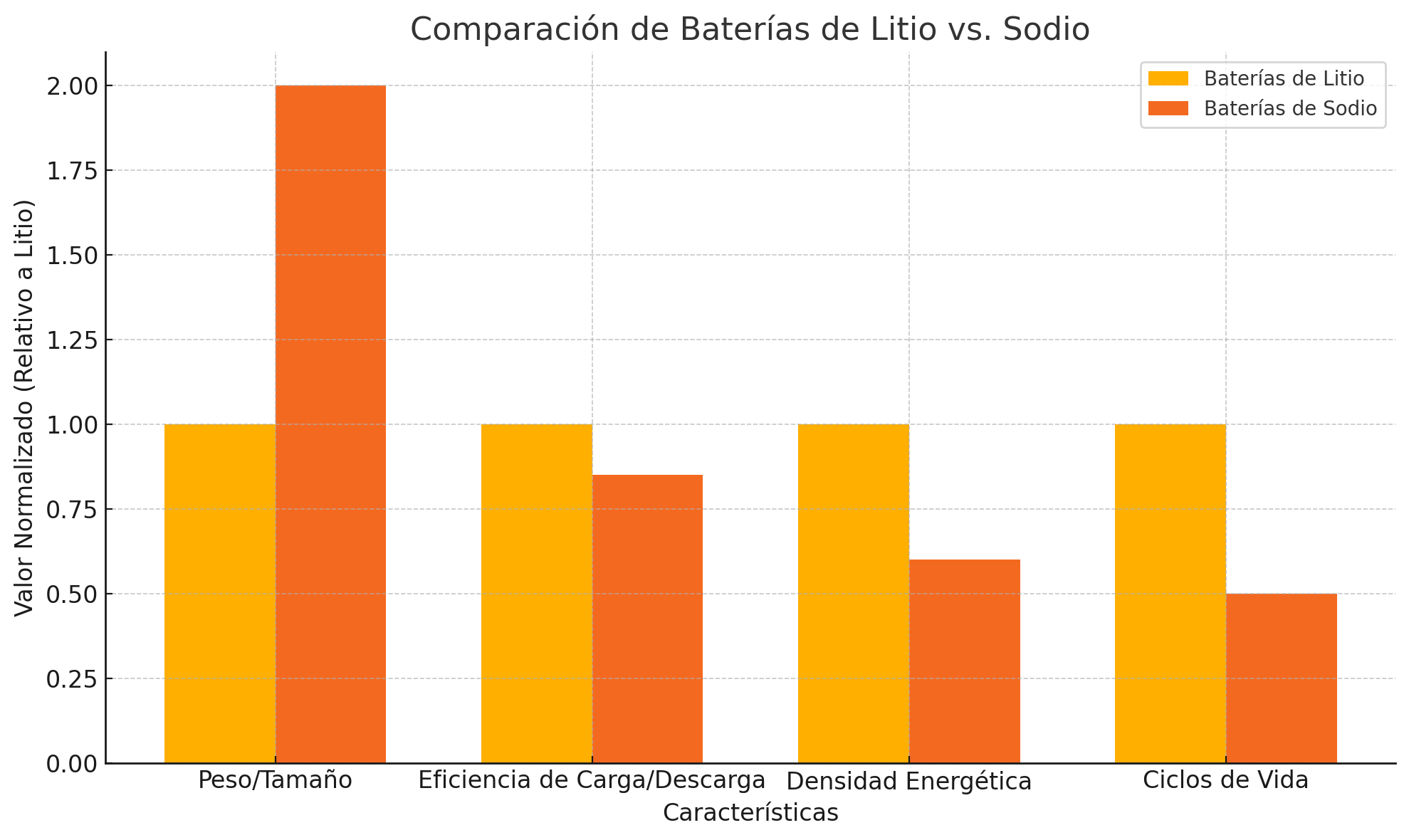
One of the main factors for comparison is energy density. Lithium batteries range from 100-265 Wh/kg, making them the ideal choice for applications where weight and space are critical, such as electric vehicles. In contrast, sodium batteries have an energy density ranging from 80-150 Wh/kg. This means that, to store the same amount of energy, a sodium battery would have to be roughly twice as large and heavy.iii
In terms of cycle life, lithium batteries can exceed 5,000 to 8,000 charge/discharge cycles, while sodium batteries, in their current version, hover around 3,000 cyclesiv. However, some recent advances have promised to increase this number, with research suggesting that up to 5,000 cycles can be achieved with new formulations. In terms of charge/discharge efficiency, lithium batteries can reach efficiencies of 90%, while sodium batteries tend to hover around 80-85%, which could make them less efficient in certain applications.v
Lithium mining has been criticized for its environmental impact, especially in South American salt flats, where the extraction process requires large amounts of water. In contrast, sodium mining is less resource intensive and less damaging to local ecosystems.
Another crucial aspect in the discussion about batteries is their recycling and sustainability. Lithium batteries contain materials such as cobalt and nickel, which are difficult to recycle and require costly and polluting processes. Only about 50% of the material in a lithium battery can be effectively recycled at present. However, sodium batteries do not contain these hazardous materials, which facilitates their recycling and disposal. It is estimated that more than 90% of the material in sodium batteries can be recycled without the use of highly polluting processes.vi
In addition, sodium is safer in terms of handling, as sodium batteries have less risk of overheating and explosion compared to lithium batteries, making them a more viable option for large-scale storage facilities in urban areas.
As for the current use of sodium batteries, they are mainly being implemented in stationary applications such as energy storage for power grids. Here, the low cost and relative simplicity of sodium batteries make them an ideal choice. For example, in solar or wind power plants, where battery size is not an issue, sodium batteries are beginning to compete with lithium batteries. vii
At the same time, some companies in the automotive sector are also beginning to explore their potential for niche electric vehicles. One example of this is the Chinese company JAC, which has announced its intention to use sodium batteries in small electric vehicles aimed at local and urban markets. Although this technology is still at an exploratory stage, the second generation of sodium batteries, expected in 2024, is expected to offer improvements in energy density and cycle life, which could expand its use in small electric vehicles. viii
The global sodium battery market was valued at USD 321.75 million in 2023 and is projected to experience robust growth at a compound annual growth rate (CAGR) of 16.3% between 2024 and 2030. This value represents only a small fraction of the lithium battery market, which is estimated at over USD 50 billion and will grow at a CAGR of 20.3% over the same period. ix
In the near term, sodium is unlikely to replace lithium in high-demand applications such as electric vehicles, where energy density and durability remain critical factors. However, sodium batteries present significant complementary value, especially in large-scale energy storage, where low cost and increased safety can overcome density and size limitations.
As the need for renewable energy storage grows, sodium appears well positioned to gain ground in low-cost, stationary applications, a niche that aligns with its current characteristics. With the right technological developments, sodium could become more than a minor player and become a competitive option that redefines the foundations of energy storage.